


The Air element
The Air Element: How to Reconnect With Your Breath
Air: the element you meet in every moment.
Air moves through everything, including us. Reconnecting begins with a single conscious breath.
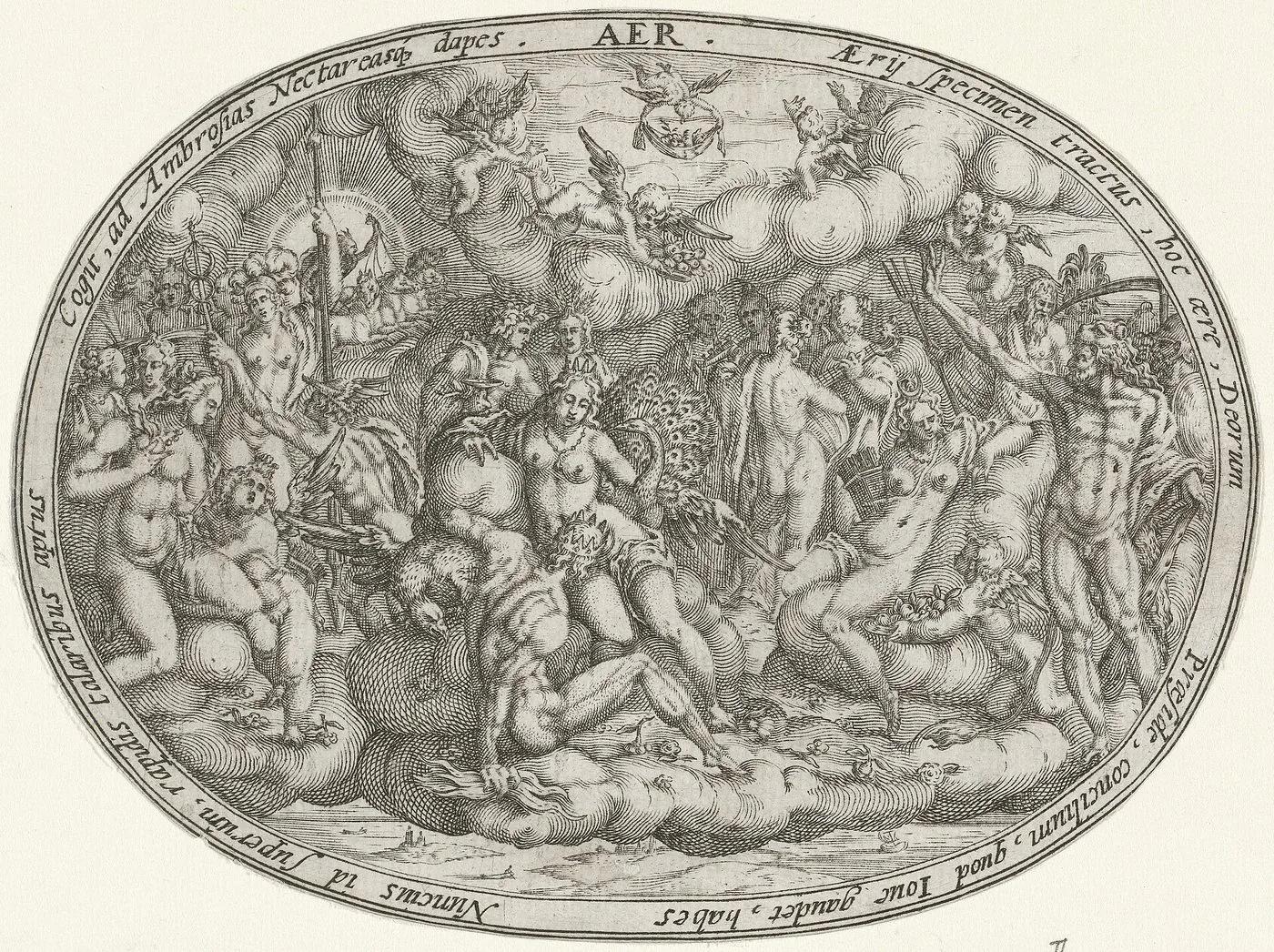
Meaning
What Is the Air Element?
Air represents breath, movement, and life. It is one of the five elements that Aquarian Alchemy invites you to reconnect with through everyday practice.
Is Air an Element?
In classical Greek philosophy and Western alchemy, Air is a symbolic element. Scientifically, the air we breathe is a mixture of gases, not a single chemical element.
Air Across Traditions
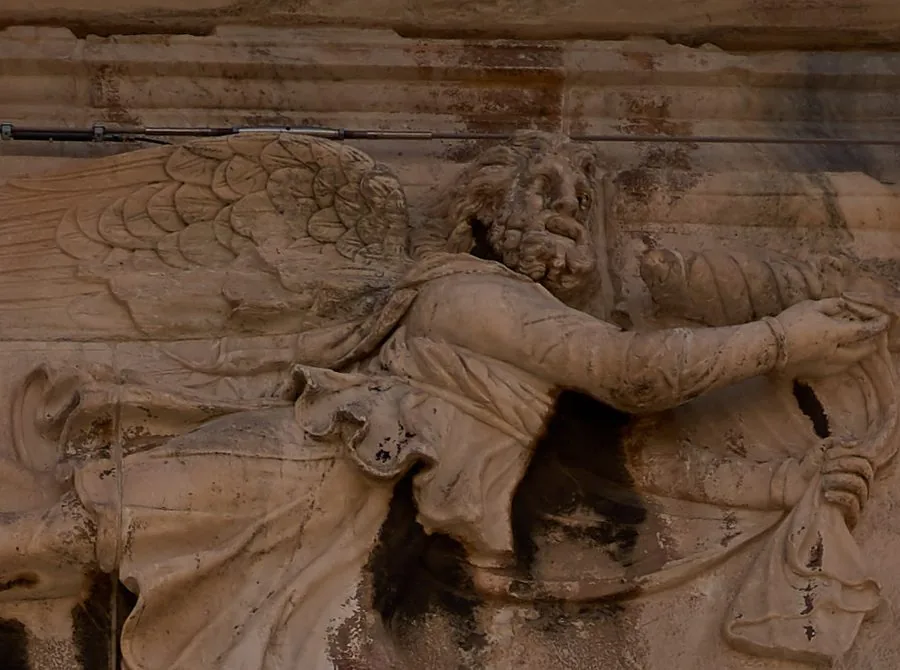
Boreas · Tower of the Winds, Athens
Greek Philosophy
Air is one of four classical elements, alongside Earth, Water, and Fire.
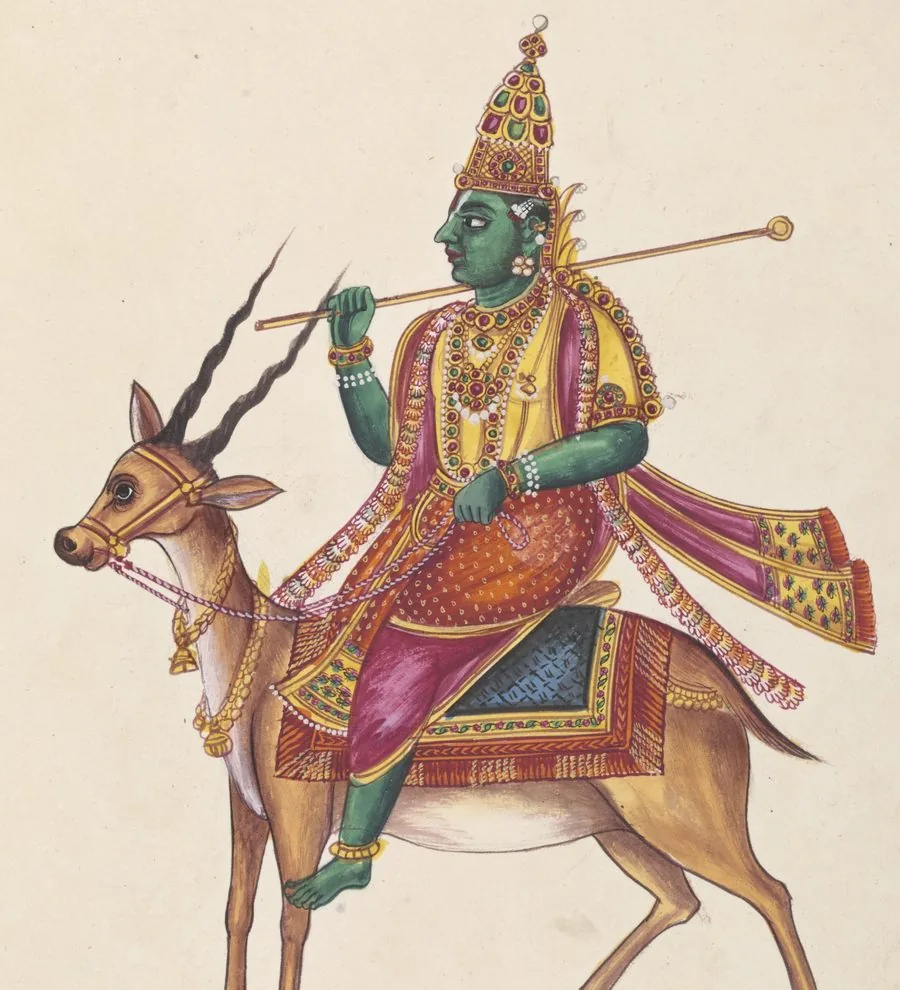
Vayu · Tamil Nadu, c. 1820–25
Yogic & Ayurvedic Traditions
Vayu means air or wind, while prana refers to vital breath or life energy.
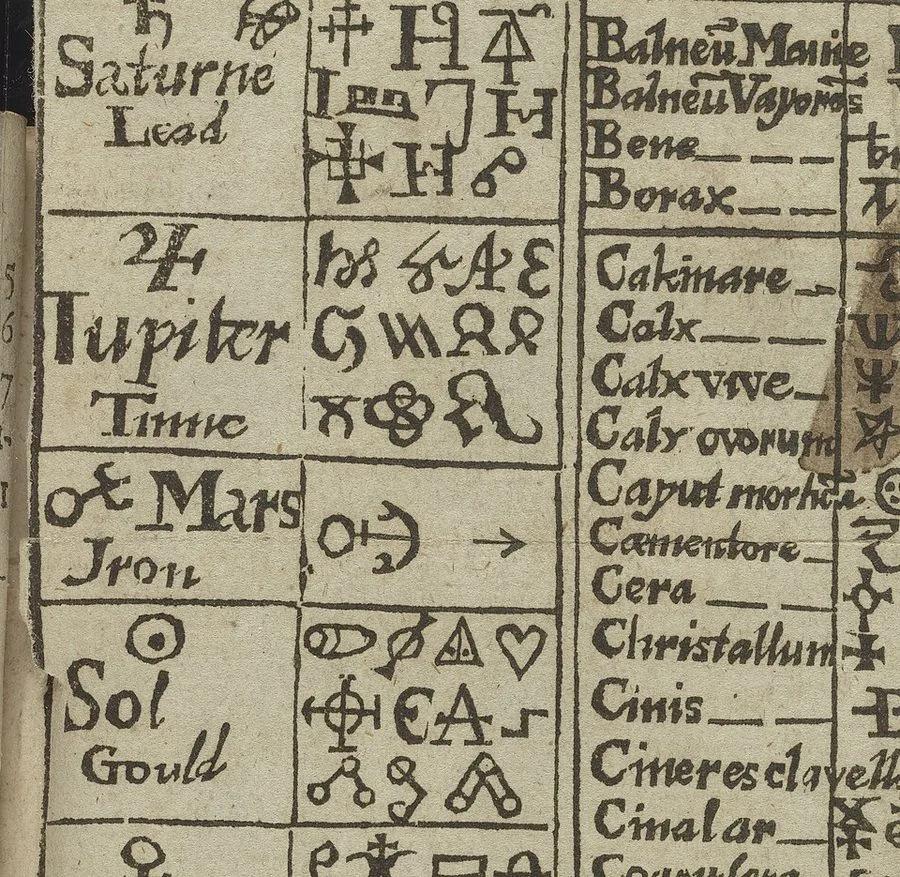
A Table of Chymicall Charecters · 1671
Western Alchemy
The air element symbol is an upward-pointing triangle crossed by a horizontal line.
The connected breath
The Connected Breath: Leonard Orr's Influence
One breath flows into the next.
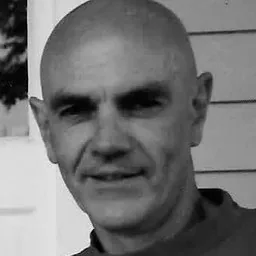
Leonard Orr developed and taught Rebirthing Breathwork, a practice of conscious connected breathing. The inhale flows into the exhale without an intentional pause.
Orr also taught spiritual purification through the elements, an influence on Aquarian Alchemy's philosophy.
The Breathwork Lineage
1962: The Beginning
According to Orr's own account, his earliest Rebirthing experience occurred in 1962.
1970s: The Practice Develops
Orr developed and shared Rebirthing Breathwork, helping establish conscious connected breathwork as a modern practice.
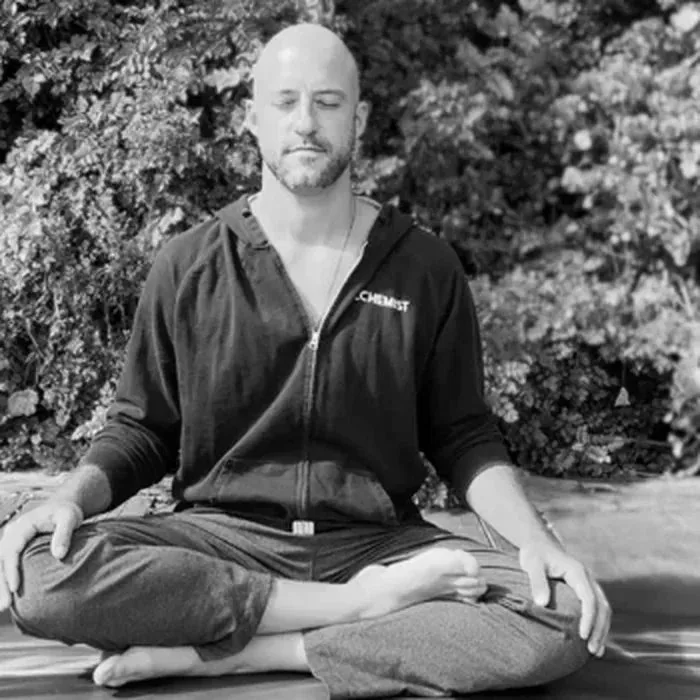
Erik Casano: The Practice Today
Erik trained with DP Mahesh in Haidakhan. He practices daily conscious breathing as well as longer sessions of connected breathwork. Aquarian Alchemy draws inspiration from Orr's teachings while using its own five-element framework, with Ether as the fifth element.
Practice
Experience a Conscious Breath
A gentle introduction, at your own pace.
Take two minutes to notice the rhythm of your own breath. No particular pace or depth is required.
How to Breathe With Your Diaphragm
You already breathe using your diaphragm. This short practice introduces the awareness behind belly breathing: noticing its natural movement without forcing a deeper breath.
- Find a comfortable seat. Let your feet rest where they feel supported, and relax your shoulders.
- Notice your breathing. If you like, place a hand below your ribs and feel your abdomen move naturally.
- Follow one breath. Let it arrive and release without forcing it. Notice the transition from inhale to exhale.
- Stay with it gently. Continue only while it feels easy. Return to your usual breathing or stop at any time.
0:00
of 2:00
Anatomy
Inside One Breath
Every breath begins with movement.
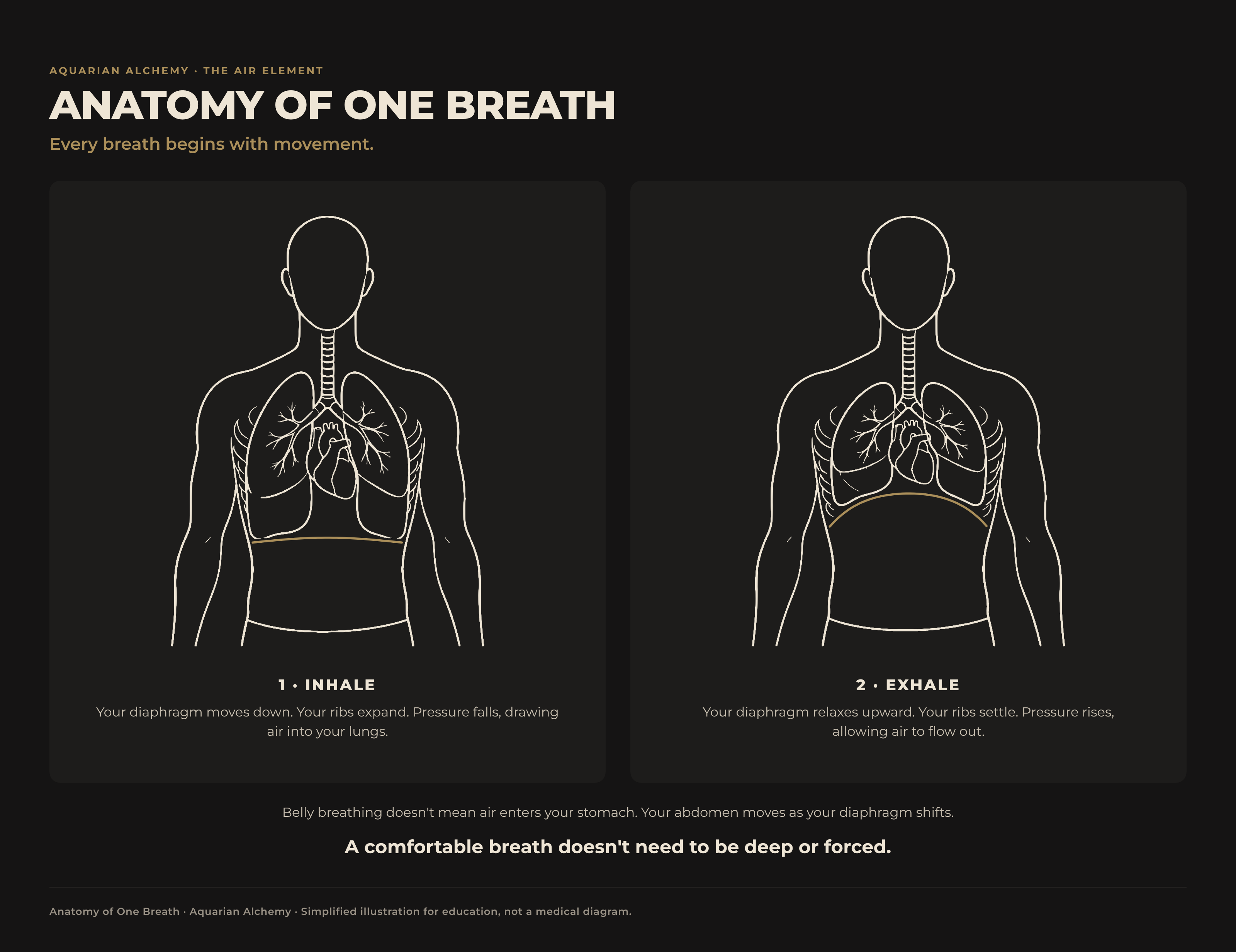
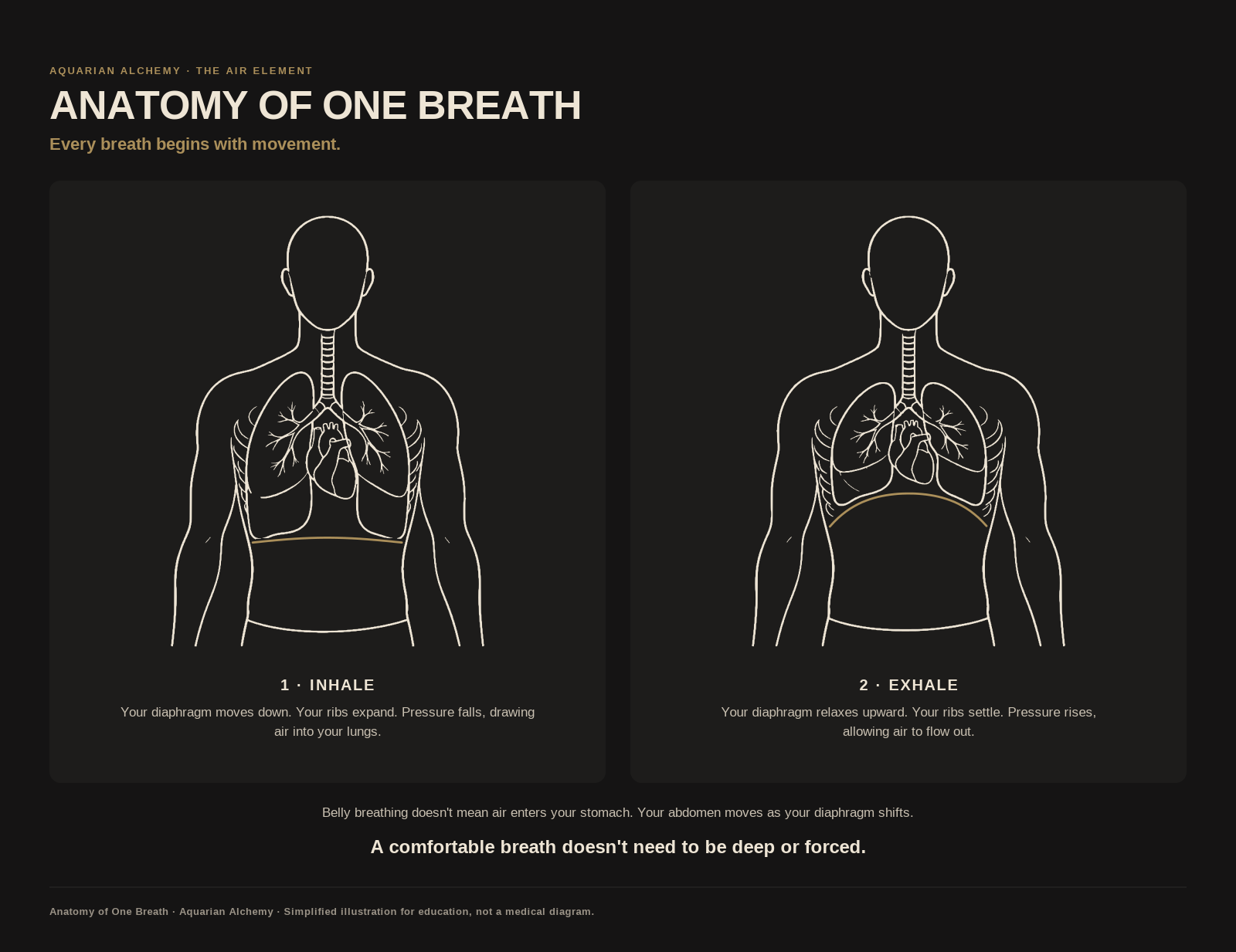
Diaphragmatic breathing is a natural partnership between your diaphragm, ribs, lungs, and changing air pressure.
Anatomy of One Breath
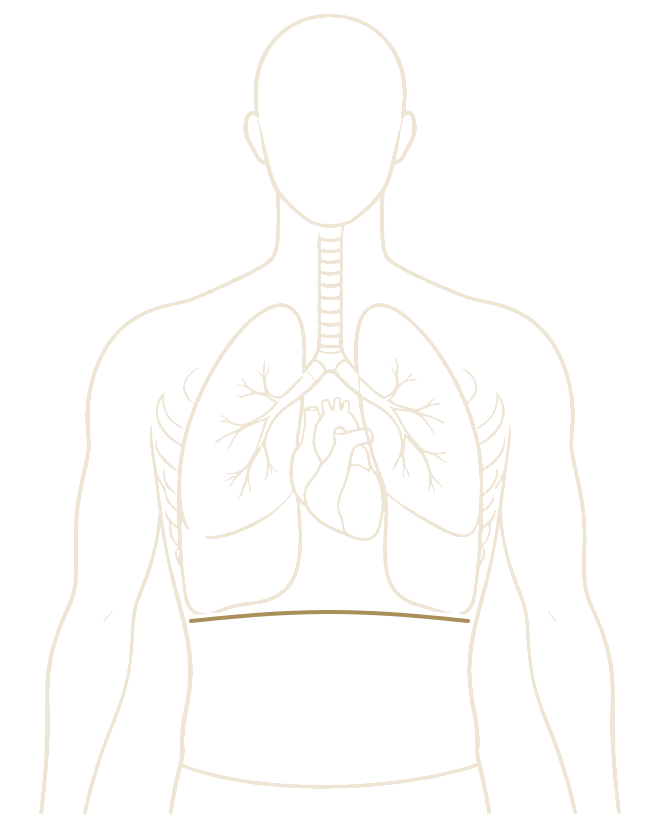
Your diaphragm moves down. Your ribs expand. Pressure falls, drawing air into your lungs.
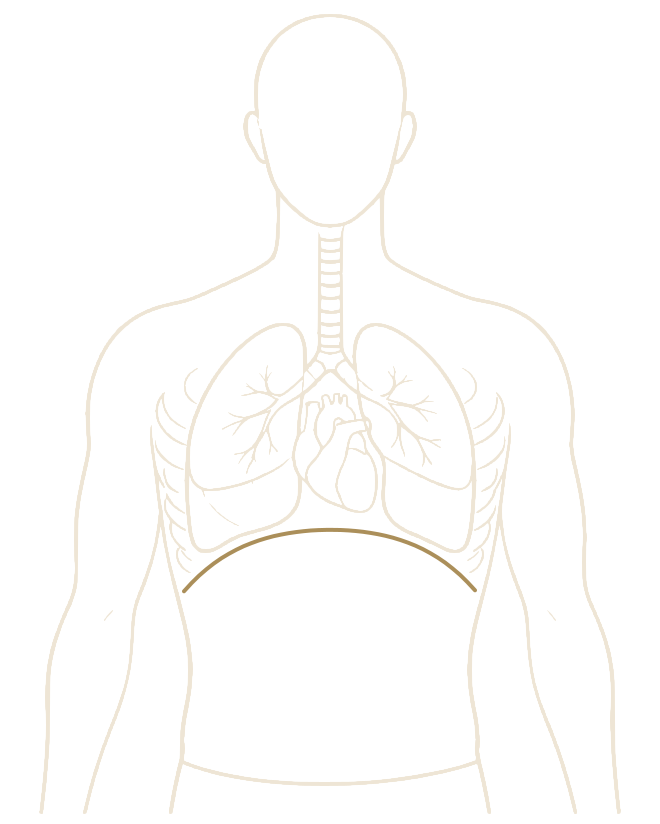
Your diaphragm relaxes upward. Your ribs settle. Pressure rises, allowing air to flow out.
Belly breathing doesn't mean air enters your stomach. Your abdomen moves as your diaphragm shifts.
A comfortable breath doesn't need to be deep or forced.
Breath spectrum
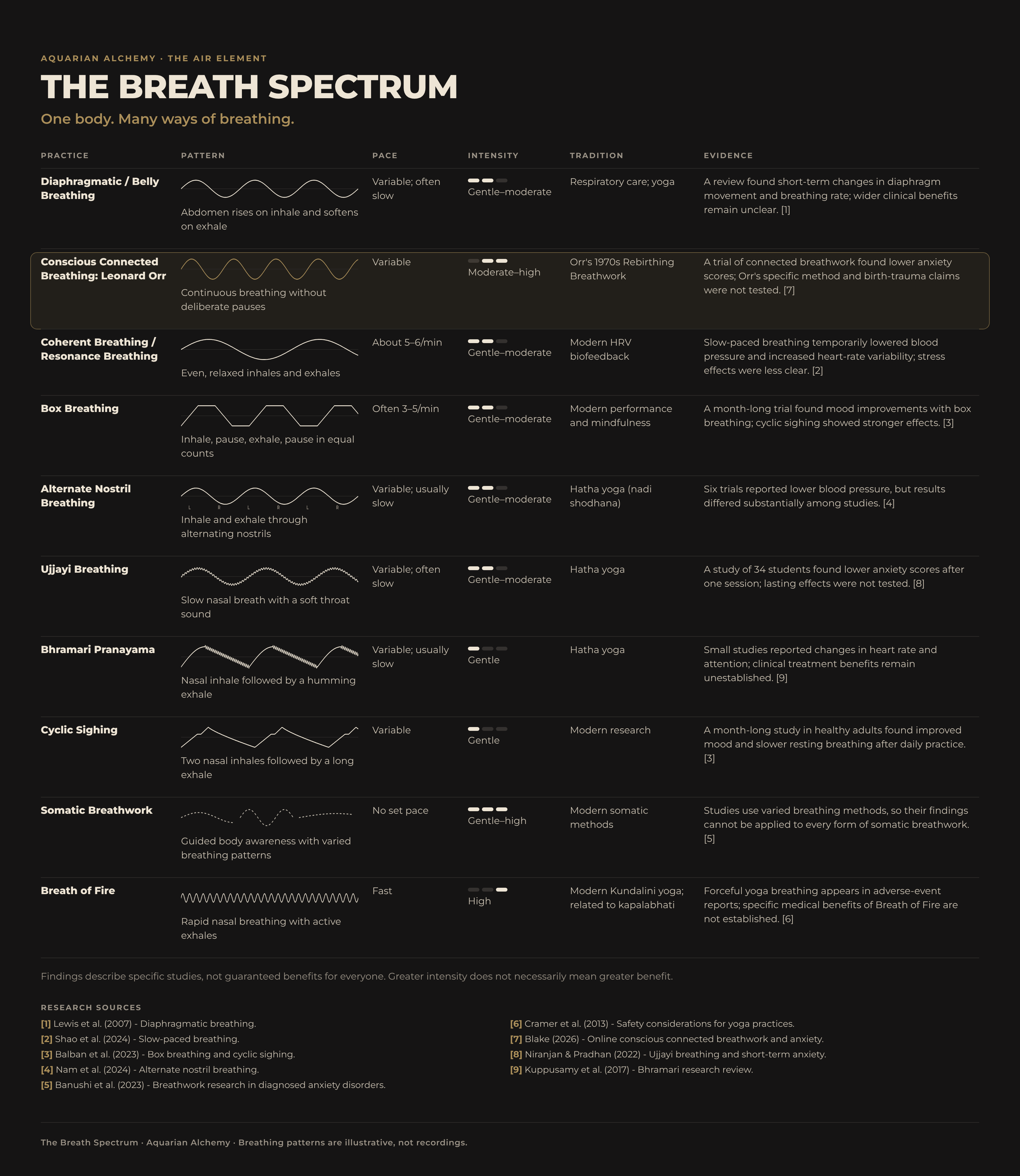
The Breath Spectrum: A Field Guide

One body. Many ways of breathing.
Different types of breathwork range from gentle awareness to more intensive techniques. Explore their rhythms, traditions, and what we actually know about them.
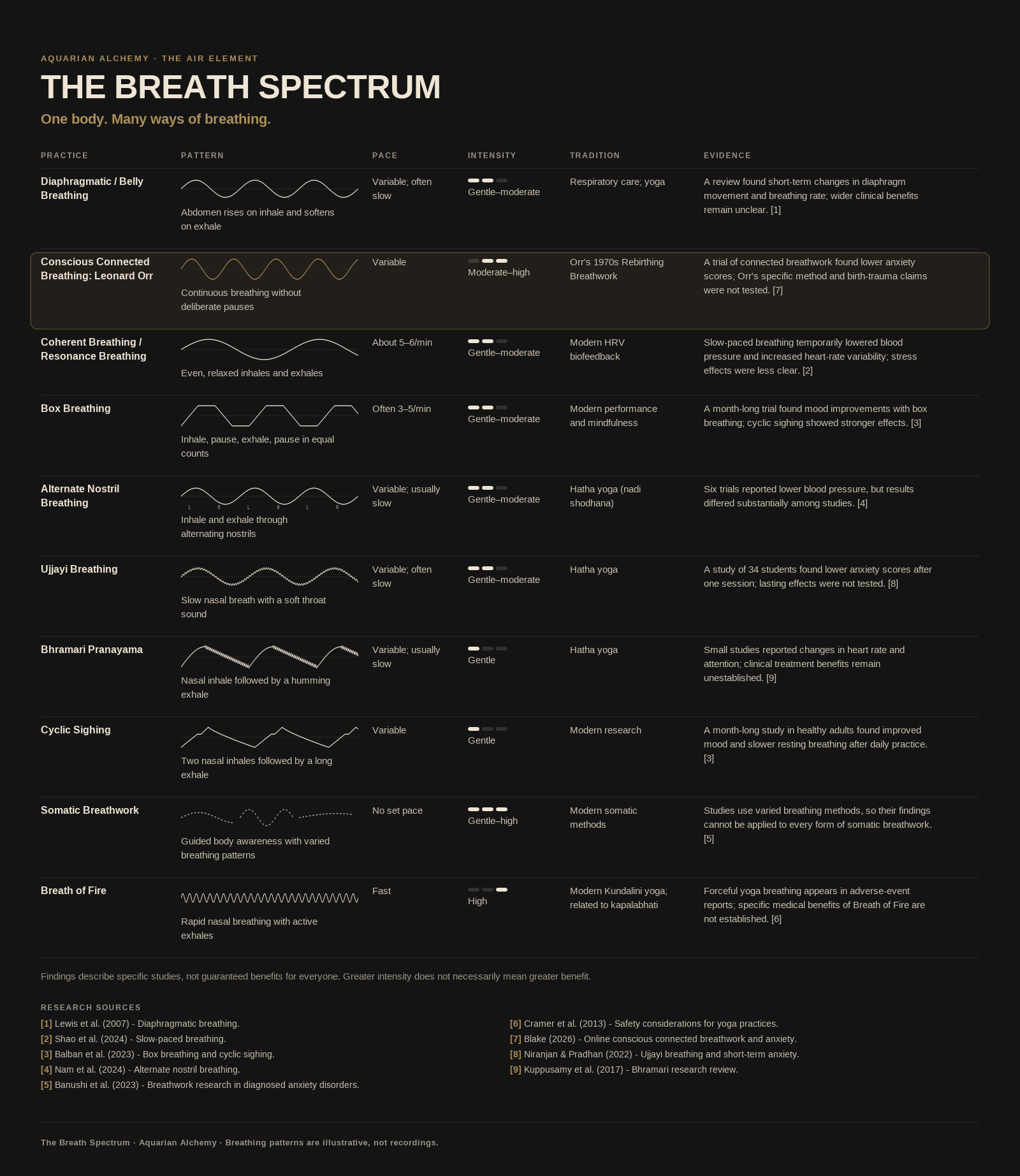
The Breath Spectrum
Diaphragmatic / Belly Breathing
Abdomen rises on inhale and softens on exhale
Pace
Variable; often slow
Intensity
Gentle–moderate
Tradition
Respiratory care; yoga
Evidence
A review found short-term changes in diaphragm movement and breathing rate; wider clinical benefits remain unclear. [1]
Conscious Connected Breathing: Leonard Orr
Continuous breathing without deliberate pauses
Pace
Variable
Intensity
Moderate–high
Tradition
Orr's 1970s Rebirthing Breathwork
Evidence
A trial of connected breathwork found lower anxiety scores; Orr's specific method and birth-trauma claims were not tested. [7]
Coherent Breathing / Resonance Breathing
Even, relaxed inhales and exhales
Pace
About 5–6/min
Intensity
Gentle–moderate
Tradition
Modern HRV biofeedback
Evidence
Slow-paced breathing temporarily lowered blood pressure and increased heart-rate variability; stress effects were less clear. [2]
Box Breathing
Inhale, pause, exhale, pause in equal counts
Pace
Often 3–5/min
Intensity
Gentle–moderate
Tradition
Modern performance and mindfulness
Evidence
A month-long trial found mood improvements with box breathing; cyclic sighing showed stronger effects. [3]
Alternate Nostril Breathing
Inhale and exhale through alternating nostrils
Pace
Variable; usually slow
Intensity
Gentle–moderate
Tradition
Hatha yoga (nadi shodhana)
Evidence
Six trials reported lower blood pressure, but results differed substantially among studies. [4]
Ujjayi Breathing
Slow nasal breath with a soft throat sound
Pace
Variable; often slow
Intensity
Gentle–moderate
Tradition
Hatha yoga
Evidence
A study of 34 students found lower anxiety scores after one session; lasting effects were not tested. [8]
Bhramari Pranayama
Nasal inhale followed by a humming exhale
Pace
Variable; usually slow
Intensity
Gentle
Tradition
Hatha yoga
Evidence
Small studies reported changes in heart rate and attention; clinical treatment benefits remain unestablished. [9]
Cyclic Sighing
Two nasal inhales followed by a long exhale
Pace
Variable
Intensity
Gentle
Tradition
Modern research
Evidence
A month-long study in healthy adults found improved mood and slower resting breathing after daily practice. [3]
Somatic Breathwork
Guided body awareness with varied breathing patterns
Pace
No set pace
Intensity
Gentle–high
Tradition
Modern somatic methods
Evidence
Studies use varied breathing methods, so their findings cannot be applied to every form of somatic breathwork. [5]
Breath of Fire
Rapid nasal breathing with active exhales
Pace
Fast
Intensity
High
Tradition
Modern Kundalini yoga; related to kapalabhati
Evidence
Forceful yoga breathing appears in adverse-event reports; specific medical benefits of Breath of Fire are not established. [6]
Findings describe specific studies, not guaranteed benefits for everyone. Greater intensity does not necessarily mean greater benefit.
Six breaths
Six Breaths a Minute: A Rhythm Worth Examining
Different traditions. A similar rhythm.
In a 2001 study of 23 healthy adults, reciting the Latin Ave Maria and a yoga mantra slowed breathing to around six breaths per minute. Both were associated with changes in heart and blood-pressure rhythms.

Two Traditions, One Observed Pace
The breathing rhythms were similar, but the traditions have different histories and meanings.
Breathing at roughly this pace is also studied in resonance breathing, a slow, paced technique that explores how breathing and heart rhythms interact. The similarity in pace does not mean these traditions were practicing the same method.
Is Slower Always Better?
Not necessarily. In a 2023 trial enrolling 400 adults, breathing at about 5.5 breaths per minute did not outperform a comparable 12-breaths-per-minute exercise on the mental-health and wellbeing outcomes measured. Both groups improved over time.
Leonard Orr's conscious connected breathing is different. It focuses on the continuous flow between inhale and exhale, rather than a fixed breathing rate.
The rhythm may change. The invitation remains the same: bring awareness to each breath.
Sources
- Bernardi et al., BMJ (2001)
- Fincham et al., Scientific Reports (2023)
Evidence and safety
What We Know, What We Don't
Understanding the difference between science and belief.
Breathing has well-understood physical mechanics, but research into different breathwork practices is still developing. Here's what the evidence tells us.
Understanding the Evidence
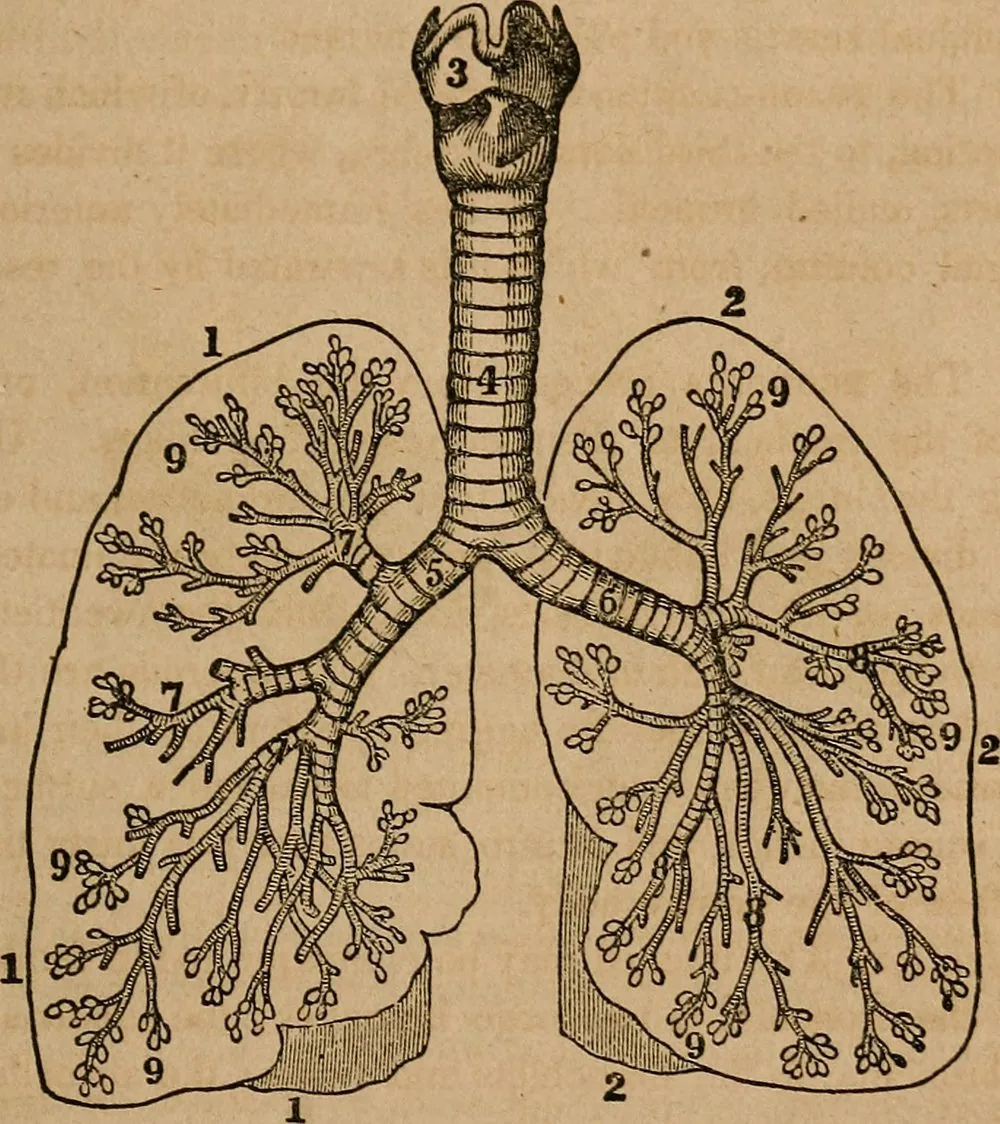
The diaphragm contracts and moves downward when we inhale, allowing the lungs to expand.
A review of 12 randomized studies involving 785 adults found that breathwork was associated with lower self-reported stress. Many studies had methodological limitations, so consider that while reviewing the source below.
A 2025 study of 61 experienced breathwork practitioners found an association between breathing-related CO₂ changes and altered experiences. It did not establish clinical benefits or safety.
Leonard Orr taught that conscious breathing and elemental practices supported spiritual purification. This is a spiritual teaching, not a proven medical effect.
Sources
- Fincham et al., Scientific Reports (2023)
- Havenith et al., Communications Psychology (2025)
Daily air
Bring Air Back Into Your Day
Small moments to reconnect with the element all around you.
Air is always present, yet we rarely stop to notice it. Reconnecting can begin with the simplest everyday experiences.
Everyday Ways to Connect With Air

Step Outside
Take a short walk when conditions are comfortable. Notice the air against your skin.
Feel the Wind
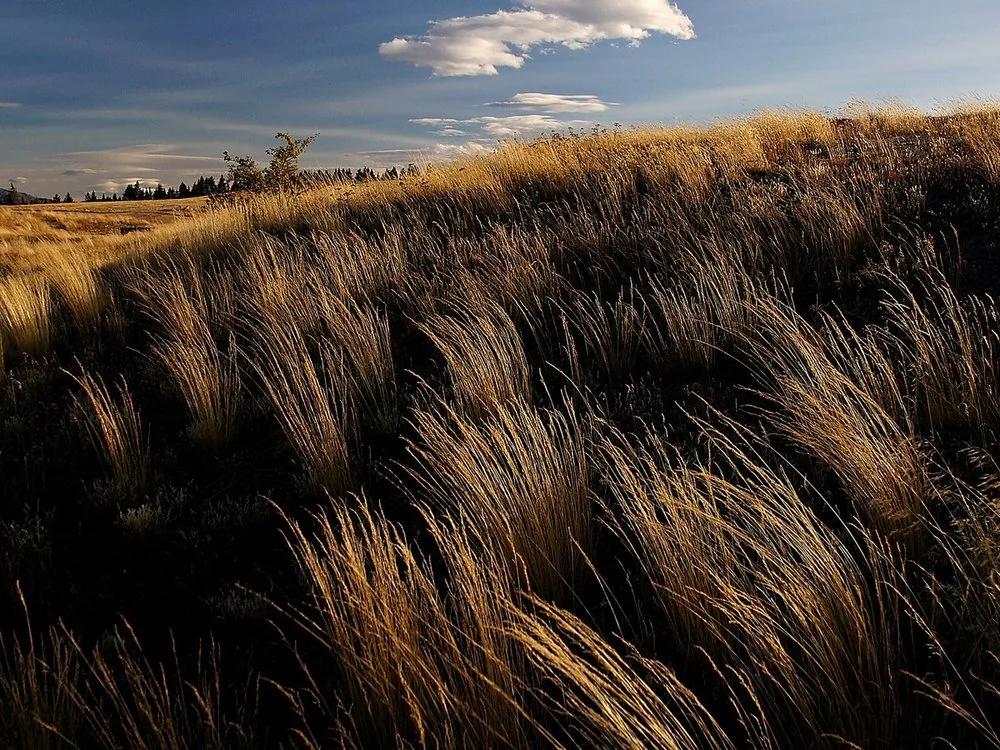
Pause to feel a breeze or watch the movement of trees and leaves.
Find a Quiet Moment
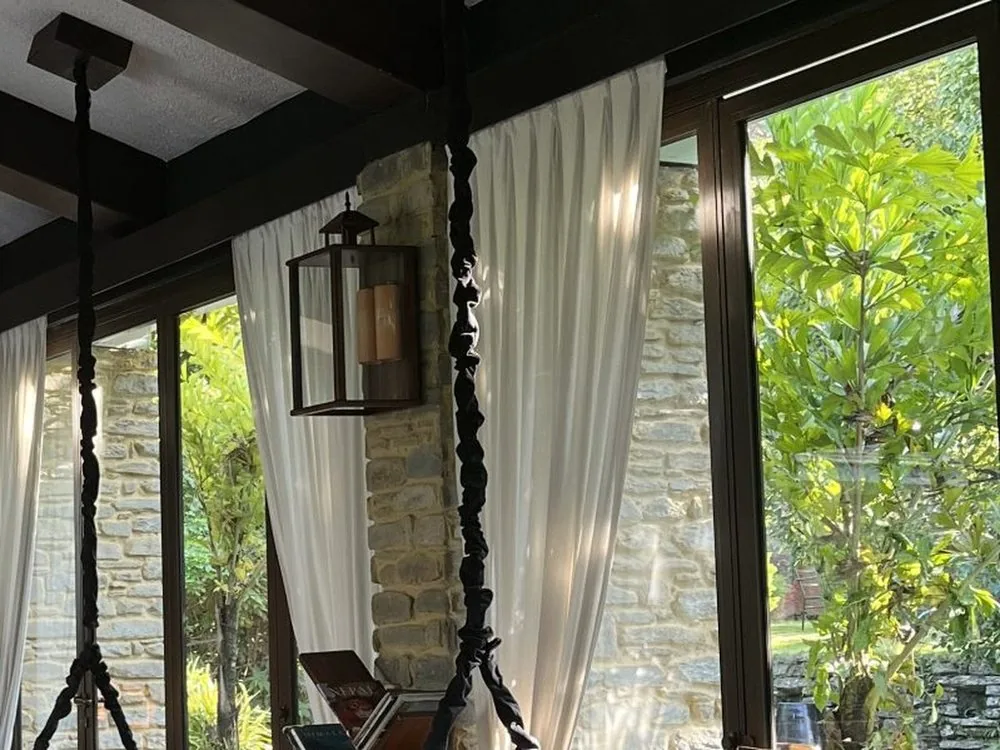
Sit comfortably and notice your natural breathing, or enjoy a breeze through an open window when outdoor conditions are suitable.

Hum Gently
Try a soft hum during a comfortable exhale. Notice the sound and vibration.
Connecting with Air doesn't require a special place or practice. Just a moment of attention.
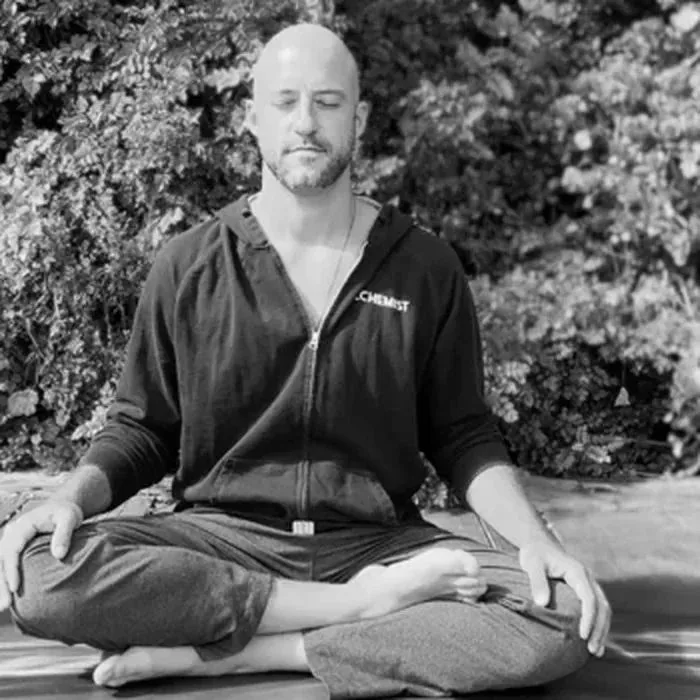
Breathe with Erik
AIR / BREATHE
Delve Deeper with Erik
You've explored the meaning, science, and everyday experience of Air. Now take the next step with Erik Casano and discover how conscious breathing can become part of your own practice.
A dedicated Air course with Erik Casano is planned. Details will be added when the course is ready.
Elements
A Practice for Every Element
Air is one part of a greater whole.
Each of the five elements offers a different way to connect with yourself and the world around you. Continue your exploration through the other four.

Earth
Reconnect With Earth
Discover mindful nourishment and the grounding rhythms of everyday life.

Water
Reconnect With Water
Explore the relationship between water, bathing, hydration, and everyday awareness.
Fire
Reconnect With Fire
Discover the power of observation through light, warmth, and fire contemplation.

Ether
Reconnect With Ether
Explore the inner world through attention, visualization, and dreams.
Every element offers a different path. Discover the one that speaks to you.
Resources
Use These Resources in Your Work
Explore, download, and share the knowledge behind the Air element.
Knowledge grows when it's shared. Explore our original educational resources, discover the research behind them, and bring these materials into your own learning, teaching, or creative work.
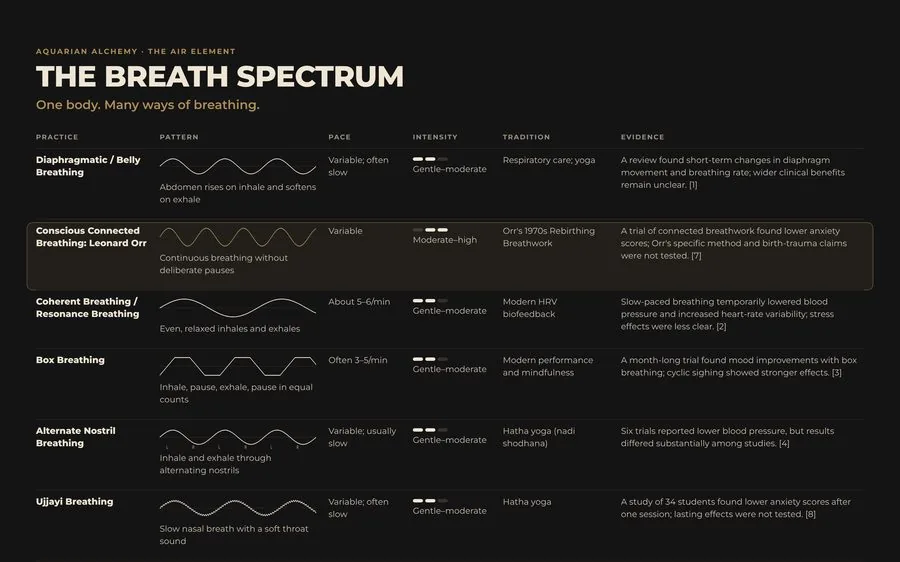
Resource 1: The Breath Spectrum
Compare breathing techniques, their patterns, traditions, and what the available research tells us about each practice.
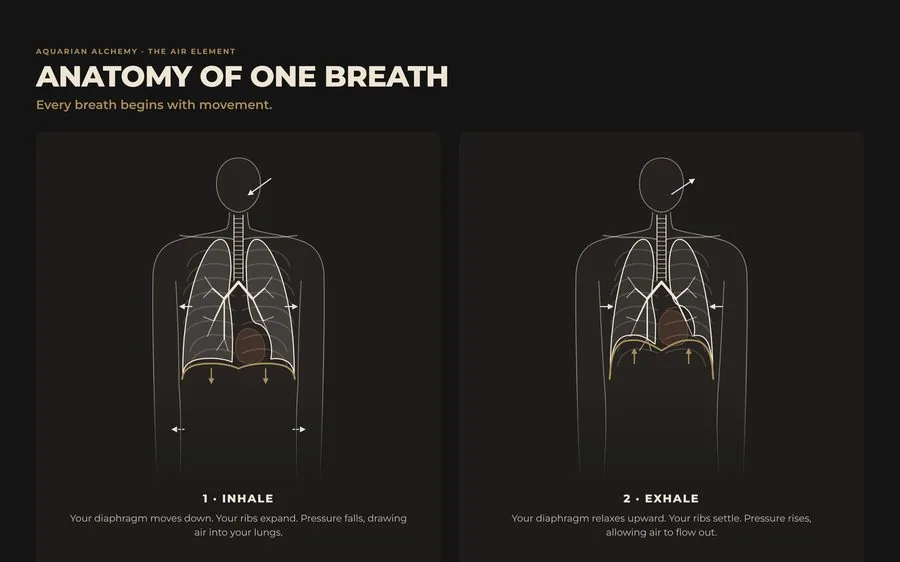
Resource 2: Anatomy of One Breath
Explore how the diaphragm, lungs, and surrounding muscles work together to make breathing possible.
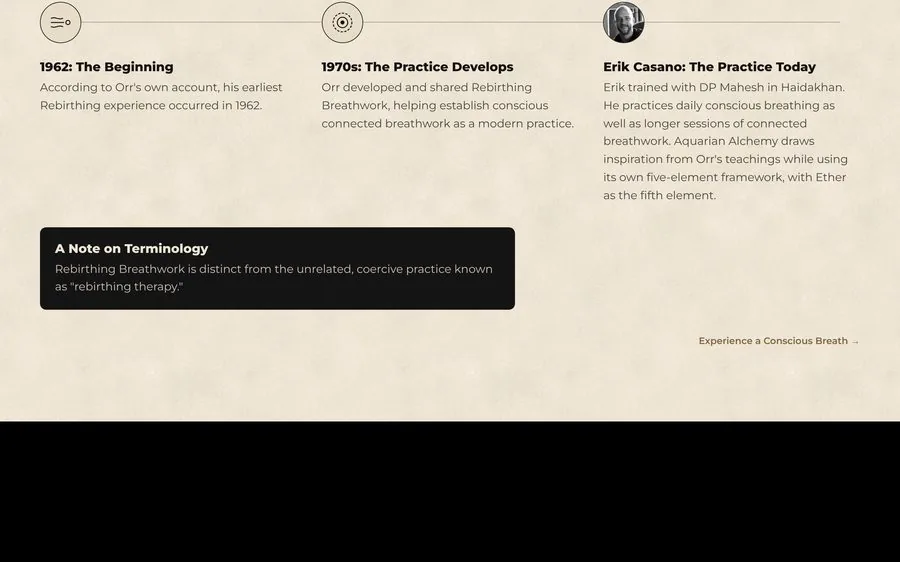
Resource 3: The Connected Breath Timeline
Trace the development of Rebirthing Breathwork, Leonard Orr's influence, and the evolution of these teachings through Erik Casano and Aquarian Alchemy.
Sources & Credits
Explore the original research, historical references, and creator credits behind each resource. We believe understanding where knowledge comes from is an important part of learning.
Breath Spectrum Research Sources
- [1]Lewis et al. (2007) - Diaphragmatic breathing.
- [2]Shao et al. (2024) - Slow-paced breathing.
- [3]Balban et al. (2023) - Box breathing and cyclic sighing.
- [4]Nam et al. (2024) - Alternate nostril breathing.
- [5]Banushi et al. (2023) - Breathwork research in diagnosed anxiety disorders.
- [6]Cramer et al. (2013) - Safety considerations for yoga practices.
- [7]Blake (2026) - Online conscious connected breathwork and anxiety.
- [8]Niranjan & Pradhan (2022) - Ujjayi breathing and short-term anxiety.
- [9]Kuppusamy et al. (2017) - Bhramari research review.
Picture credits
- Olympic gods among the clouds: Aer, c. 1620–60Abraham van den Hecken the Elder, Rijksmuseum, CC0
- Boreas, Tower of the Winds, AthensGeorge E. Koronaios, CC BY-SA 4.0, via Wikimedia Commons
- Vayu, god of the wind, c. 1820–25Public domain, via Wikimedia Commons
- A Table of Chymicall & Philosophicall Charecters, 1671Public domain
- A Treatise on Anatomy, Physiology and Hygiene, 1850Public domain, via Wikimedia Commons
- The great outdoorsClarisse Meyer, CC0, via Wikimedia Commons
- Tussocks in the windBernard Spragg, CC0, via Openverse
- A cozy indoor lounge areasweekar7, CC0, via Openverse